
Noodle Texture Analysis & Machine
Noodle Tensile Test
Ensuring Consistent Quality with Noodle Texture Analysis
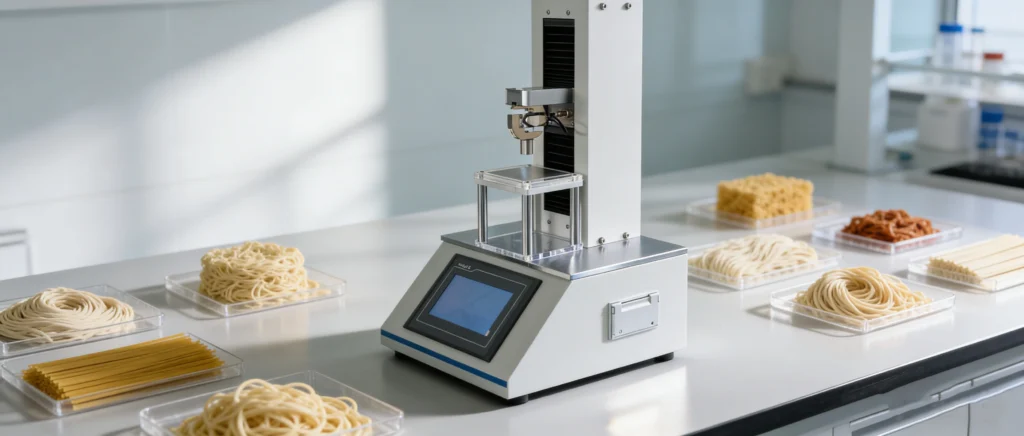
Noodle Texture Analyzer
About Us
Cell Instruments specializes in high-precision noodle texture analyzers designed for the food industry. We provide solutions for tensile tests on noodles, spaghetti, and related pasta products, helping food manufacturers and quality control labs measure texture, elasticity, and break strength. Our instruments ensure products meet desired standards for quality, mouthfeel, and consumer satisfaction.
Reliable Bekk Smoothness Testing for Quality Assurance
How to Measure Texture with Noodle and Spaghetti Texture Analyzers
Understanding noodle texture is crucial for consumer satisfaction. Texture influences perceived quality, cooking performance, and mouthfeel. Accurate noodle texture analysis allows manufacturers to:
- Sample Preparation: Cook noodles or spaghetti to the desired consistency, ensuring uniformity across samples.
- Clamping: Secure the noodle strands using the analyzer’s grips without causing pre-test deformation.
- Application of Force: Gradually apply tensile force along the strand’s length until breakage occurs.
- Data Recording: Measure parameters such as maximum tensile strength, elongation at break, and elasticity, which reflect the noodle’s mechanical properties.
These tests help manufacturers quantify texture, validate processing parameters, and maintain batch-to-batch consistency.
Key Parameters in Noodle Tensile Testing
A noodle texture analyzer evaluates multiple parameters that define product quality:
- Breaking Force: The maximum stress the noodle can withstand before snapping.
- Elongation: The distance a noodle stretches before breaking, indicating elasticity.
- Firmness: Resistance to deformation during tensile application.
- Texture Profile Analysis (TPA): Some advanced analyzers allow multi-cycle testing to simulate chewing behavior and overall mouthfeel.
Accurate measurement of these parameters ensures that cooked noodles meet expected standards for texture and consumer satisfaction.
Factors Affecting Tensile Test Results
Several factors influence the accuracy and relevance of noodle tensile tests:
01
Moisture Content
Higher moisture can increase elasticity but reduce break strength.
02
Cooking Time
Overcooked noodles yield lower tensile strength; undercooked noodles can be brittle.
03
Noodle Thickness and Shape
Different diameters or strand types affect stretching behavior.
03
Temperature
Testing at consistent temperatures ensures comparability across batches.
Understanding these variables allows manufacturers to interpret results correctly and optimize production.
Recommended Instrument: Cell Instruments TEX-01
The Cell Instruments TEX-01 is specifically designed for noodle tensile testing. Its features include:
- Adjustable grips for various noodle sizes.
- High-resolution force and displacement measurement.
- Programmable testing speeds for consistent protocols.
- Compatibility with Texture Profile Analysis for in-depth evaluation.
Using the TEX-01 ensures reproducibility, accuracy, and reliable data for product optimization.

Applicable Fields and Typical Applications
Noodle and Pasta Production
Ensures consistent firmness, elasticity, and chewiness in noodles and pasta through tensile, cutting, and TPA texture measurements.
Instant Noodles Quality Control
Monitors texture of pre-fried or air-dried noodles, maintaining bite and mouthfeel after cooking.
R&D and Product Development
Supports formulation optimization and new product development with TPA, gel strength, and tensile tests.
Sensory Correlation
Correlates instrumental texture data with consumer perception of chewiness and firmness for reliable product quality.
Why Choose Cell Instruments
Cell Instruments provides industry-leading solutions for noodle texture testing:
- High Precision: Accurate and repeatable measurements of tensile strength and elasticity.
- Versatility: Suitable for dry, fresh, or specialty noodle products.
- Customization: Tailored grips and testing protocols for unique noodle types.
- Expert Support: Technical guidance for method selection, calibration, and data interpretation.
Partnering with Cell Instruments helps manufacturers maintain superior noodle quality while improving production efficiency.
Importance of Tensile Testing for Noodle Quality
Tensile tests provide essential insights beyond visual inspection. Key benefits include:
- Ensuring batch-to-batch consistency.
- Optimizing noodle formulations for desired elasticity and firmness.
- Supporting product development and new recipe evaluation.
- Reducing consumer complaints about noodle breakage or undesirable texture.
For manufacturers of dry and fresh noodles, tensile testing serves as a cornerstone of quality assurance.
Frequently Asked Questions about Noodle Texture Analyzer
What is the purpose of a noodle tensile test?
A noodle tensile test measures the mechanical properties of noodle and spaghetti products, including breaking force, elasticity, and elongation, which are essential for evaluating texture quality and cooking performance.
How should noodle samples be prepared for testing?
Samples should be cooked or hydrated consistently according to product specifications. Ensure uniformity in noodle strand diameter, length, and temperature to obtain reproducible results.
Can the noodle tensile test help in product development?
Yes. By analyzing tensile properties, manufacturers can optimize recipes, adjust gluten or starch content, and refine cooking parameters to achieve the desired texture and mouthfeel in both dry and fresh noodles.