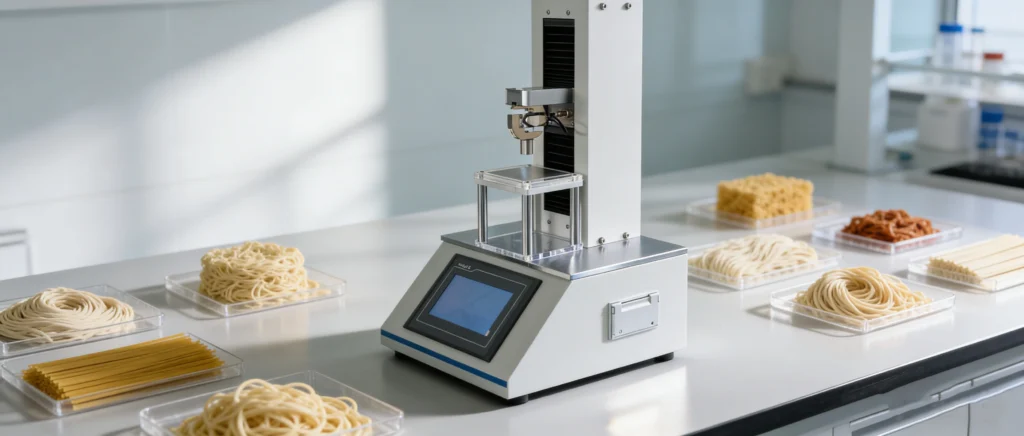
면 질감 분석 및 기계
면 인장 시험
Ensuring Consistent Quality with Noodle Texture Analysis
면 질감 분석기
About Us
Cell Instruments는 고정밀 전문 기업입니다. noodle texture analyzers designed for the food industry. We provide solutions for tensile tests on noodles, spaghetti, and related pasta products, helping food manufacturers and quality control labs measure texture, elasticity, and break strength. Our instruments ensure products meet desired standards for quality, mouthfeel, and consumer satisfaction.
품질 보증을 위한 신뢰할 수 있는 Bekk 평활도 테스트
How to Measure Texture with Noodle and Spaghetti Texture Analyzers
면의 식감을 이해하는 것은 소비자 만족을 위해 매우 중요합니다. 식감은 인지된 품질, 조리 성능 및 식감에 영향을 미칩니다. 정확성 면의 질감 분석 를 사용하면 제조업체가
- Sample Preparation: Cook noodles or spaghetti to the desired consistency, ensuring uniformity across samples.
- Clamping: Secure the noodle strands using the analyzer’s grips without causing pre-test deformation.
- Application of Force: Gradually apply tensile force along the strand’s length until breakage occurs.
- Data Recording: Measure parameters such as maximum tensile strength, elongation at break, and elasticity, which reflect the noodle’s mechanical properties.
These tests help manufacturers quantify texture, validate processing parameters, and maintain batch-to-batch consistency.
Key Parameters in Noodle Tensile Testing
A 면 질감 분석기 evaluates multiple parameters that define product quality:
- Breaking Force: The maximum stress the noodle can withstand before snapping.
- Elongation: The distance a noodle stretches before breaking, indicating elasticity.
- Firmness: Resistance to deformation during tensile application.
- Texture Profile Analysis (TPA): Some advanced analyzers allow multi-cycle testing to simulate chewing behavior and overall mouthfeel.
Accurate measurement of these parameters ensures that cooked noodles meet expected standards for texture and consumer satisfaction.
Factors Affecting Tensile Test Results
Several factors influence the accuracy and relevance of noodle tensile tests:
01
Moisture Content
Higher moisture can increase elasticity but reduce break strength.
02
Cooking Time
Overcooked noodles yield lower tensile strength; undercooked noodles can be brittle.
03
Noodle Thickness and Shape
Different diameters or strand types affect stretching behavior.
03
Temperature
Testing at consistent temperatures ensures comparability across batches.
Understanding these variables allows manufacturers to interpret results correctly and optimize production.
Recommended Instrument: Cell Instruments TEX-01
그리고 Cell Instruments TEX-01 is specifically designed for noodle tensile testing. Its features include:
- Adjustable grips for various noodle sizes.
- High-resolution force and displacement measurement.
- Programmable testing speeds for consistent protocols.
- Compatibility with Texture Profile Analysis for in-depth evaluation.
Using the TEX-01 ensures reproducibility, accuracy, and reliable data for product optimization.
적용 가능한 분야 및 일반적인 애플리케이션
국수 및 파스타 생산
인장, 절단 및 TPA 텍스처 측정을 통해 면과 파스타의 일관된 견고성, 탄력성 및 쫄깃함을 보장합니다.
인스턴트 면류 품질 관리
미리 튀기거나 공기 건조된 면의 식감을 모니터링하여 조리 후에도 씹는 맛과 식감을 유지합니다.
R&D 및 제품 개발
TPA, 겔 강도 및 인장 테스트를 통해 제형 최적화 및 신제품 개발을 지원합니다.
감각 상관관계
계측 질감 데이터와 소비자의 씹힘 및 단단함에 대한 인식의 상관관계를 파악하여 신뢰할 수 있는 제품 품질을 제공합니다.
Why Choose Cell Instruments
Cell Instruments provides industry-leading solutions for noodle texture testing:
- High Precision: Accurate and repeatable measurements of tensile strength and elasticity.
- Versatility: Suitable for dry, fresh, or specialty noodle products.
- Customization: Tailored grips and testing protocols for unique noodle types.
- Expert Support: Technical guidance for method selection, calibration, and data interpretation.
Partnering with Cell Instruments helps manufacturers maintain superior noodle quality while improving production efficiency.
Importance of Tensile Testing for Noodle Quality
Tensile tests provide essential insights beyond visual inspection. Key benefits include:
- Ensuring batch-to-batch consistency.
- Optimizing noodle formulations for desired elasticity and firmness.
- Supporting product development and new recipe evaluation.
- Reducing consumer complaints about noodle breakage or undesirable texture.
For manufacturers of dry and fresh noodles, tensile testing serves as a cornerstone of quality assurance.
누들 텍스처 분석기에 대해 자주 묻는 질문
What is the purpose of a noodle tensile test?
A noodle tensile test measures the mechanical properties of noodle and spaghetti products, including breaking force, elasticity, and elongation, which are essential for evaluating texture quality and cooking performance.
How should noodle samples be prepared for testing?
Samples should be cooked or hydrated consistently according to product specifications. Ensure uniformity in noodle strand diameter, length, and temperature to obtain reproducible results.
Can the noodle tensile test help in product development?
Yes. By analyzing tensile properties, manufacturers can optimize recipes, adjust gluten or starch content, and refine cooking parameters to achieve the desired texture and mouthfeel in both dry and fresh noodles.