
Spaghetti quality is determined not only by appearance and taste but also by its mechanical properties during cooking, handling, and consumption. Consumers expect spaghetti to maintain suitable firmness, elasticity, and bite characteristics after preparation. For manufacturers, controlling these texture properties is essential to ensure product consistency and meet market expectations.
Traditional sensory evaluation provides valuable information, but it depends heavily on personal experience and may vary between operators. Therefore, instrumental testing has become an important approach for objectively evaluating noodle characteristics.
A texture analyzer provides quantitative measurements of important noodle properties, including hardness, elasticity, adhesiveness, firmness, and tensile strength. Through controlled mechanical testing, manufacturers can better understand how ingredients, processing conditions, and cooking methods influence spaghetti quality.
Noodle Tensile Test: Methods for Spaghetti Quality Evaluation
A texture analyzer is a multifunctional instrument designed to simulate the mechanical actions involved in food consumption, such as biting, chewing, stretching, and compression. In spaghetti evaluation, it provides accurate and repeatable data for product development and quality control.
A comprehensive noodle test usually includes several evaluation methods depending on the target quality characteristics:
- Compression testing for firmness and hardness evaluation
- Tensile testing for elasticity and extensibility
- Texture Profile Analysis (TPA) for chewing characteristics
- Bending or fracture testing for structural strength
Among these methods, the Noodle Tensile test is especially important for spaghetti because noodles are elongated products that must withstand stretching during cooking, processing, and serving.
The tensile properties reflect the strength of the gluten network and the internal structure formed during manufacturing.
Why Texture Testing Is Important for Spaghetti Products
The texture of spaghetti directly affects consumer acceptance. A high-quality product should maintain a balanced combination of firmness, flexibility, and elasticity.
Texture testing helps manufacturers evaluate:
Cooking performance
The structure of spaghetti changes significantly after hydration. Instrumental testing can measure how cooking time affects firmness and elasticity.
Ingredient optimization
Changes in flour type, protein content, additives, or processing parameters can influence noodle texture. A texture analyzer helps compare different formulations objectively.
Batch consistency
Large-scale production requires stable quality between batches. Regular texture testing identifies variations before products reach consumers.
Product development
New noodle products can be optimized by comparing texture characteristics with existing market products.
Principle of Noodle Tensile Test for Spaghetti
De Noodle Tensile test measures the force required to stretch spaghetti until deformation or breakage occurs.
During the test, a cooked or uncooked spaghetti sample is fixed between two grips. The texture analyzer then moves one grip at a controlled speed while continuously recording the applied force and extension distance.
Important parameters obtained from the test include:
- Maximum tensile force
- Tensile distance
- Elasticity
- Breaking point
A higher tensile force generally indicates stronger noodle structure, while excessive brittleness may indicate insufficient flexibility.
This testing method provides valuable information about molecular interactions within the noodle matrix, particularly the development of gluten-related structures.
How a Texture Analyzer Performs Spaghetti Testing
A typical spaghetti texture analysis process includes several steps.
First, samples are prepared according to the testing requirements. For cooked spaghetti evaluation, cooking time and water conditions must be controlled carefully because they strongly influence texture results.
The sample is then positioned on the testing fixture of the texture analyzer. Suitable probes or grips are selected depending on the required analysis method.
For tensile evaluation, specialized grips hold the spaghetti sample while the instrument applies a controlled stretching force. The system records force changes throughout the test.
For compression-based analysis, a probe compresses the sample to simulate chewing behavior and measures resistance during deformation.
The collected data allows researchers and quality control teams to compare different products and identify texture differences.
Factors Affecting Spaghetti Texture Performance
Many factors influence spaghetti texture characteristics:
Raw material properties
Protein content, starch quality, and flour composition determine the basic structure of noodles.
Processing conditions
Mixing, extrusion, drying temperature, and drying time affect internal organization.
Cooking conditions
Cooking duration and water absorption significantly influence firmness and elasticity.
Storage conditions
Temperature and humidity changes may affect product stability over time.
By combining controlled testing with sensory evaluation, manufacturers can develop a clearer understanding of product performance.
Application of Texture Analyzer in Noodle Product Development
The application of a texture analyzer extends beyond routine quality inspection. It supports research and development activities in the noodle industry.
Manufacturers can use texture analysis to:
- Compare different spaghetti formulations
- Evaluate new ingredients
- Optimize cooking recommendations
- Monitor production stability
- Establish objective quality standards
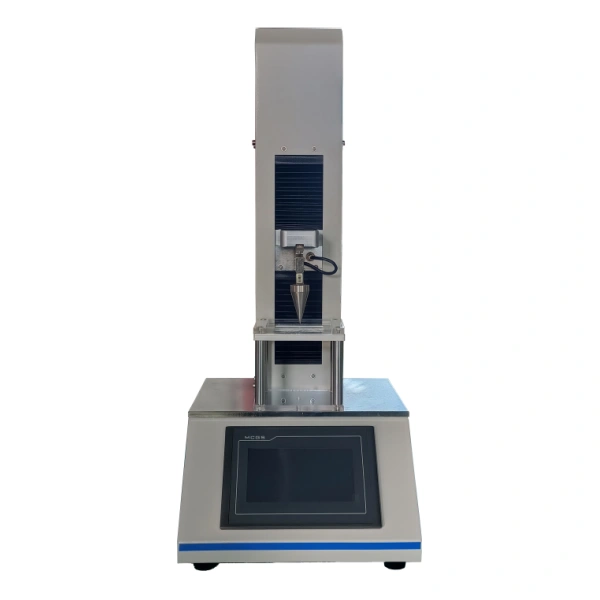
For companies producing pasta and noodle products, a reliable texture analyzer provides scientific data that supports faster product improvement.
De Cell Instruments Texture Analyzer can be used for various food texture evaluations, including spaghetti and other noodle products. With flexible testing modes and adjustable parameters, it helps food manufacturers perform compression, tensile, and texture profile analysis according to different product requirements.
Improving Spaghetti Quality Through Instrumental Texture Analysis
Modern food production requires accurate and repeatable quality evaluation methods. Sensory testing alone cannot fully describe the mechanical properties of spaghetti, especially when manufacturers need to compare formulations or maintain large-scale production consistency.
By applying a professional texture analyzer, producers can transform texture characteristics into measurable data. The combination of noodle test methods and Noodle Tensile test results provides deeper insight into product structure, cooking performance, and consumer eating experience.
Instrumental texture analysis has become an important tool for improving spaghetti quality and supporting innovation in the noodle industry.